Boat Travel Time Calculator
Enter the distance and your speed to get the travel time and arrival, or enter the time you have to find the speed you need.
This boat travel time calculator works out how long a passage takes and when you arrive. Enter the distance and your speed, in nautical miles, miles or kilometres and in knots, mph or km/h, and it returns the travel time in days, hours and minutes. Add a departure date and time and it adds the travel time to give an ETA.
It also works backwards. Enter the distance and the time you have, and it shows the speed over ground you need. Optional inputs for current, stops and a safety margin make the estimate closer to a real passage. The tool is free, runs in your browser, and nothing you type is uploaded.
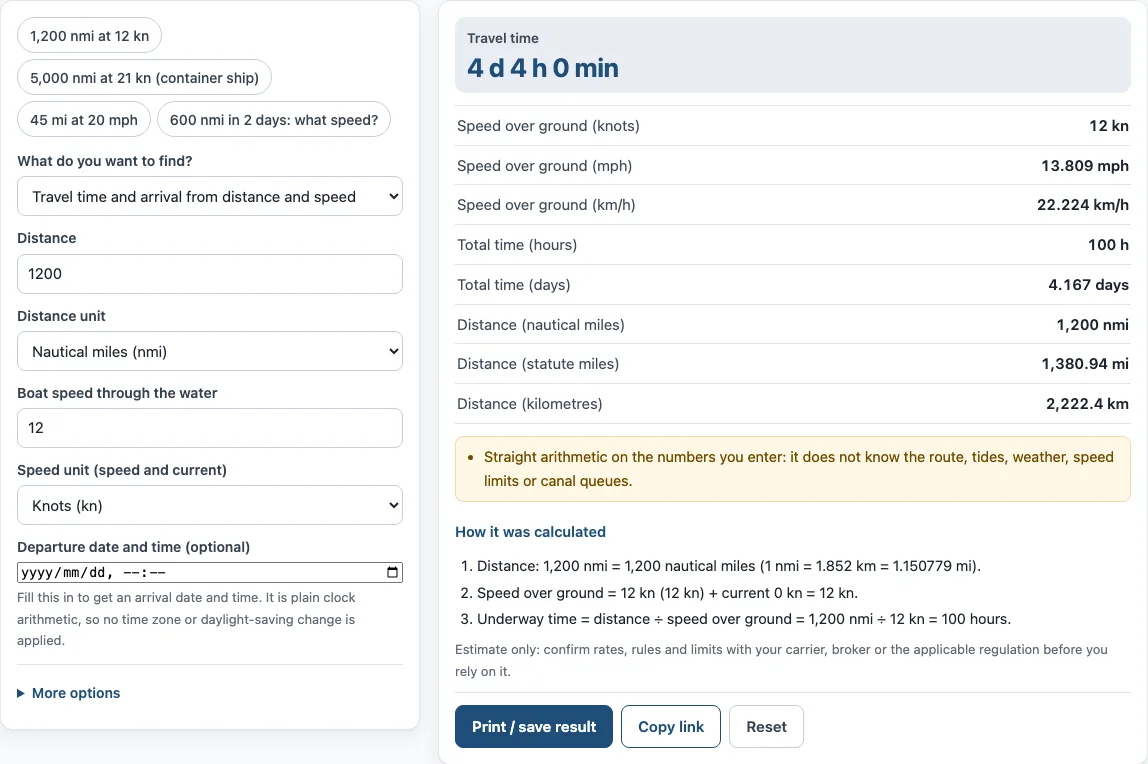
How to use the boat travel time calculator
- Under What do you want to find?, choose “Travel time and arrival from distance and speed” or “Speed needed to arrive in a set time”.
- Enter the Distance and pick the Distance unit: nautical miles, statute miles or kilometres.
- For travel time, enter your Boat speed through the water and pick the Speed unit. For the speed mode, enter the Time available in days and extra hours instead.
- Optionally pick a Departure date and time to get an arrival date and time.
- Open More options to enter a Current along the course (positive if it helps you), Stops and waiting time in hours and a Safety margin in percent.
- Read the Travel time and Arrival at the top of the results. Below them you will find the speed over ground in knots, mph and km/h, the total time in hours and days, and the distance in all three units.
- Check How it was calculated for each step.
Use a preset such as “1,200 nmi at 12 kn” or “600 nmi in 2 days: what speed?” to see how it works. Copy link shares your inputs, Print / save result prints a one-page sheet, and Reset clears them.
How do you calculate boat travel time?
Divide the distance by the speed over ground. Travel time = distance ÷ speed, with both in the same distance unit per hour. Because a knot is one nautical mile per hour, a distance in nautical miles divided by a speed in knots gives hours directly.
For example, 1,200 nautical miles at 12 knots takes 1,200 ÷ 12 = 100 hours, which is 4 days and 4 hours. For a lake trip of 45 miles at 20 mph, the time is 2.25 hours, or 2 hours 15 minutes. If your distance is in kilometres and your speed in km/h, the same division works.
How do you calculate an ETA?
Add the travel time to the departure date and time. A boat leaving on Thursday 1 October 2026 at 08:00 and travelling for 100 hours arrives on Monday 5 October 2026 at 12:00. The calculator does this with plain clock arithmetic, so it applies no time zone change and no daylight-saving shift. If you cross time zones, convert the result yourself.
How does current change the travel time?
Current adds to or subtracts from your speed over ground (SOG). Your boat speed through the water plus a helping current gives the faster SOG. On the 1,200 nautical mile passage at 12 knots, a 2-knot helping current gives a SOG of 14 knots and a time of 85.7 hours (3 days 13 hours 43 minutes). A 2-knot current against you gives 10 knots and 120 hours, which is 5 days.
How fast do I need to go to arrive on time?
Choose the speed mode. To cover 600 nautical miles in 2 days (48 hours), you need 600 ÷ 48 = 12.5 knots over ground, which is 14.38 mph or 23.15 km/h. If stops take 6 hours, only 42 hours remain underway, and the speed needed rises to 14.29 knots.
How long does a container ship take on a long voyage?
At an economical speed of about 21 knots, a ship covers roughly 504 nautical miles a day. A passage of 5,000 nautical miles takes 238.1 hours, which is 9 days 22 hours 6 minutes. Many container lines moved to about 21 knots in the early 2010s, down from earlier top speeds of 25 knots or more.
What is the difference between speed through the water and speed over ground?
Speed through the water is how fast the hull moves relative to the water. Speed over ground is how fast it moves relative to the seabed, so it includes the current. Travel time depends on speed over ground, which is why the calculator adds the current to your boat speed.
Sources
Definitions and figures used by this tool (checked October 2026):
- Knot (unit), Wikipedia: a knot is one nautical mile per hour; speed over ground and speed through the water are both given in knots
- Nautical mile, Wikipedia: the international nautical mile is exactly 1,852 m
- NIST Special Publication 811: 1 statute mile = 1,609.344 m
- Container ship, Wikipedia: economical voyage speed of about 21 knots compared with earlier top speeds of 25 or more
Frequently asked questions
What is the formula for boat travel time?
Time = distance ÷ speed over ground. Speed over ground = boat speed through the water + current along the course (positive if the current helps). The calculator then multiplies the underway time by one plus your safety margin and adds any stops.
How many hours does it take to go 100 nautical miles?
At 10 knots it takes 10 hours, at 20 knots 5 hours, and at 5 knots 20 hours. Divide the distance by the speed in knots. The calculator also converts miles and kilometres for you.
Does the calculator account for tides and weather?
No. It does simple arithmetic on the numbers you enter. It does not know the route, tides, weather, speed limits, locks or canal queues. Use the current, margin and stops fields to approximate them, and keep a larger margin for rough weather.
Does the ETA change with time zones?
No. The arrival is the departure clock time plus the travel time, with no time zone conversion and no daylight-saving change. If the destination is in another time zone, adjust the result yourself.
How is the safety margin applied?
The margin is a percentage added to the underway time only. A 10 % margin turns 100 hours underway into 110 hours. Stops are added after the margin, so a 6-hour stop makes the total 116 hours.
What speed should I use for a cargo ship?
Use the service speed from your vessel or voyage plan. As a rough guide, many container lines use about 21 knots, but bulk carriers, tankers and feeder ships differ. The calculator does not assume a speed.
Can I use the results for voyage planning or quotes?
You may use the results in commercial work, including quotes, schedules and plans, without attribution. They are estimates, so confirm the schedule with your carrier or the vessel’s master before you rely on it.
Related tools
- Knots to mph converter: use it to convert a speed between knots, mph and km/h.
- Sea distance calculator: use it to measure the distance between two ports in nautical miles.
- Trucking cost per mile calculator: use it to price a road leg.
- Container loading calculator: use it to see how many cartons fit in a container.
- All logistics calculators: use it to browse every calculator on this site.