Bridge Formula Calculator
Enter the axle weights and spacings of your truck to check every axle group against the Federal Bridge Formula.
At a glance
Bridge Formula Calculator is a free browser tool that takes each axle's weight and spacing and checks every group of consecutive axles against the federal bridge formula, returning Pass or fail, the allowed and actual gross weight and the tightest group.
- The formula is W = 500 × (L × N ÷ (N − 1) + 12N + 36), where L is the outer-axle distance in feet and N is the number of axles.
- Two axles 31 ft apart give 122 × 500 = 61,000 lb, and three axles spanning 9 ft give 42,500 lb.
- With five axles, reaching 80,000 lb needs about 51.2 ft between the outer axles, and at 50 ft the group drops to 79,000 lb.
- The tandem exception allows 34,000 lb per tandem, or 68,000 lb total, when the outer axles are 36 ft or more apart.
- A Pass means every group is within its bridge formula limit for the inputs entered, and it does not replace state rules or permits.
Sources: 23 CFR 658.17 Weight (eCFR) (checked 2026-10-15) · Bridge Formula Weights (FHWA Freight Management and Operations) (checked 2026-10-15)
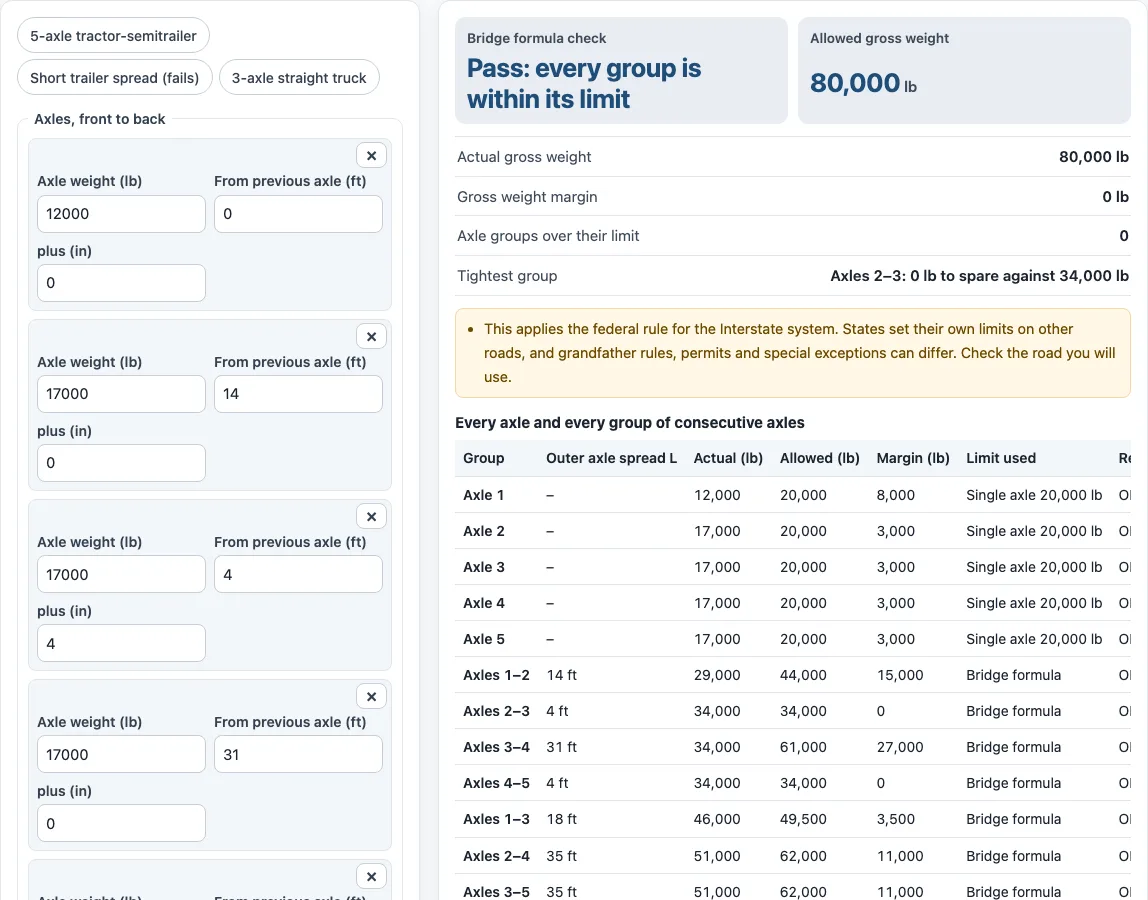
How to use the Bridge formula calculator
- Start with the example values, or pick a preset: “5-axle tractor-semitrailer”, “Short trailer spread (fails)” or “3-axle straight truck”.
- List the axles front to back, with one line per axle.
- On each line, enter the Axle weight (lb).
- In From previous axle (ft), enter the distance from the axle before, centre to centre. Use plus (in) for any extra inches; the first axle has no spacing.
- Click “+ Add an axle” to add a line, or × to remove one.
- Read Bridge formula check. It says Pass or fail.
- Compare Allowed gross weight, Actual gross weight and Gross weight margin.
- Check Axle groups over their limit and Tightest group.
- Scan the table “Every axle and every group of consecutive axles” to see which groups are close to their limit.
- Open “How it was calculated” under the result to see each step with your numbers.
“Print / save result” produces a one-page sheet with your inputs, results, calculation steps and the date. To keep the sheet as a file, choose Save as PDF in the print dialog. “Copy link” copies a link that reopens the same inputs, and the page address keeps your inputs after every change. “Reset” restores the example values.
What is the federal bridge formula?
The federal bridge formula limits the weight on any group of two or more consecutive axles on the Interstate system. Each group’s maximum depends on how far apart its outer axles are and how many axles it has, so spreading axles out allows more weight.
The formula sits alongside other federal limits: 20,000 lb on a single axle, 34,000 lb on a tandem (axles more than 40 inches and up to 96 inches apart), and 80,000 lb gross. It is set out in 23 U.S.C. 127 and 23 CFR 658.17 as Bridge Formula B.
How do you calculate the bridge formula?
Use W = 500 × (L × N ÷ (N − 1) + 12N + 36). W is the maximum weight in pounds on the group, L is the distance in feet between the outer axles, and N is the number of axles in the group.
- Measure L between the first and last axle of the group, to the nearest foot.
- Count N, the number of axles in the group.
- Work out L × N ÷ (N − 1) + 12N + 36.
- Multiply by 500.
- Round to the nearest 500 lb. An exact half rounds down.
For example, two axles 31 ft apart give 31 × 2 ÷ 1 + 24 + 36 = 122, and 122 × 500 = 61,000 lb. Three axles spanning 9 ft give 42,500 lb.
Why does a 5-axle truck need 51 feet for 80,000 lb?
With five axles, the formula becomes W = 500 × (1.25L + 96). Reaching 80,000 lb needs L of about 51.2 ft, so 51 ft between the outer axles gives 79,875 lb, which rounds up to 80,000 lb. At 50 ft the group drops to 79,000 lb.
FHWA’s own worked example uses a five-axle truck with 51 ft between its first and last axles. In the tool’s default example, the five axles span 53 ft, so the formula allows 81,000 lb, but the 80,000 lb gross limit applies.
What is the tandem axle exception at 36 feet?
Two consecutive tandems may each carry 34,000 lb, or 68,000 lb in total, when the first and last axles of the two tandems are 36 ft or more apart. The formula alone would give only 66,000 to 67,500 lb for spreads of 36 to 38 ft, so the exception allows more weight than the formula does.
Does the bridge formula apply on every road?
No. The federal formula applies to the Interstate system. States set their own limits on non-Interstate roads, and grandfather rights and permits can differ, so check the rules that apply to your route.
Sources
Data and rules used by this tool (checked October 2026):
Frequently asked questions
Does the tool store the numbers I enter?
Nothing you type is uploaded. The calculator runs in your browser, so your axle weights and spacing stay on your device.
What does “Tightest group” mean?
It names the group of consecutive axles with the least weight to spare under its limit. If the check fails, that group is usually the first one to fix.
Can I use the results on quotes, invoices or shipping plans?
Yes. Results may be used in commercial work without attribution. The tool is for estimation only, so verify critical designs against the applicable standard and regulations.
Does a Pass mean the load is legal to drive?
A Pass means every group is within its bridge formula limit under the inputs you entered. It does not replace state rules, permits or other federal limits, so confirm those for your route.
How are the axle spacings rounded?
The distance between the outer axles of each group is taken to the nearest foot, and an exact half foot rounds up to the next whole foot, as state bridge-formula rules put it (for example the Idaho Transportation Department’s). Enter feet and inches as measured, centre to centre of the axles; the tool rounds each group’s length and shows the rounded figure in the table, so you can check it against your own measurements.
Related tools
- Axle weight calculator: use it to check the weight carried by each axle before you apply the bridge formula.
- Truck loading calculator: use it to plan how cargo is placed so axle weights stay balanced.
- Trucking cost per mile calculator: use it to estimate the running cost of a trip once the load is planned.
- Truck driver pay calculator: use it to estimate driver earnings for a route.