CBM Calculator
Enter each carton or pallet size and quantity to get total cubic meters (CBM), cubic feet and how much of a container it fills.
At a glance
CBM Calculator is a free browser tool that multiplies the length, width, height and quantity of each carton or pallet, in cm or inches, to return total cubic metres, cubic feet and the share of a 20 ft or 40 ft container.
- To convert cubic centimetres to cubic metres, divide by 1,000,000, since 1 m³ equals 1,000,000 cm³.
- One EUR pallet measuring 120 × 80 × 100 cm is 0.96 m³, so four of these pallets give 3.84 m³.
- To change m³ into cubic feet, multiply by 35.3147, so 3.84 m³ is 135.61 ft³.
- Published capacities are 33.2 m³ for a 20 ft standard container, 67.7 m³ for a 40 ft standard and 76.4 m³ for a 40 ft high cube.
- Air cargo converts volume to weight at 6,000 cm³ per kg (IATA), so 3.84 m³ gives a chargeable air weight of 640 kg.
Sources: Cubic metre (Wikipedia) (checked 2026-10-15) · Dry shipping containers (SeaCube Containers) (checked 2026-10-15)
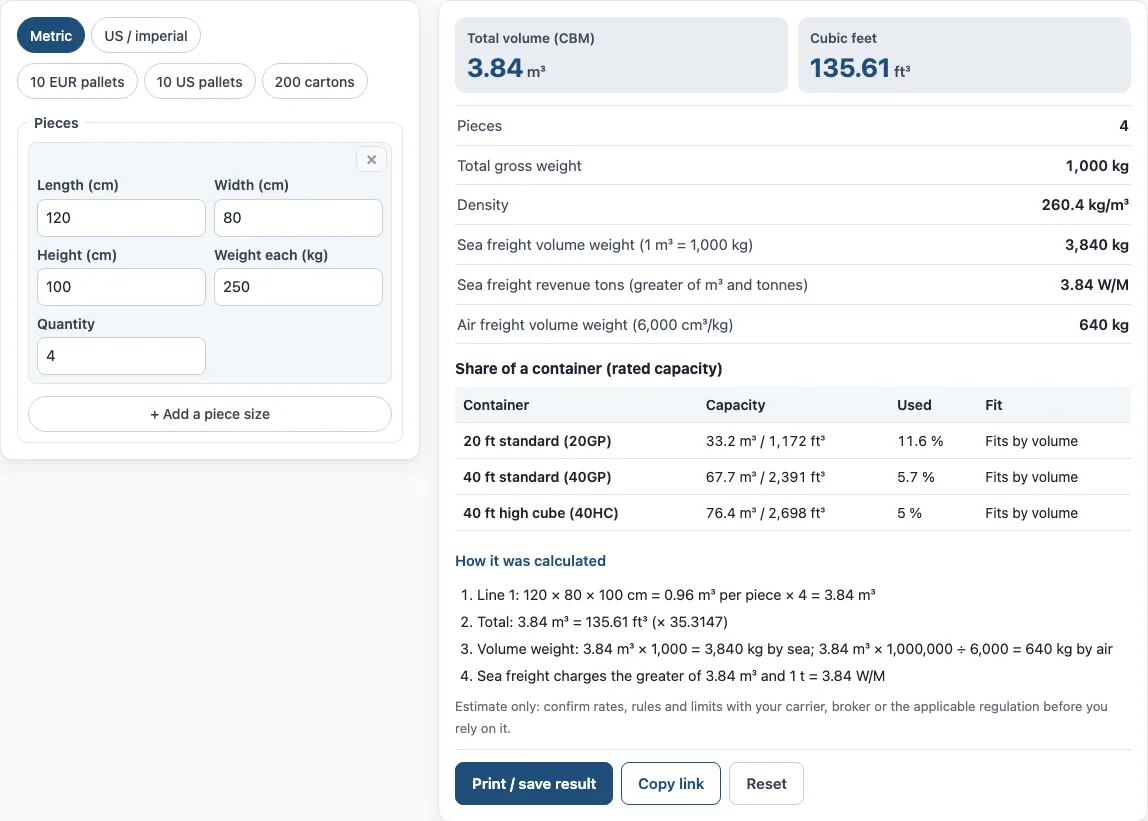
How to use the CBM calculator
- Choose your units with the switch: “Metric” or “US / imperial”. Typed values convert when you switch, so check them after you change it.
- In Pieces, type the Length, Width and Height of one item. Each field accepts cm or in, depending on the unit you chose.
- Enter the Weight each in kg or lb.
- Enter the Quantity of identical items.
- To add another size of item, select “+ Add a piece size” and fill in a new line. To remove a line, select ×.
- To start from a common load, select a preset: “10 EUR pallets”, “10 US pallets” or “200 cartons”. Then change the numbers if your goods differ.
- Read the results: Total volume (CBM), Cubic feet, Pieces, Total gross weight, Density, and the freight volume weights. Check the share of a container table to see how full a 20 ft or 40 ft box would be.
- Open “How it was calculated” under the result to see each step with your own numbers.
When you are done, select “Print / save result” to print a one-page sheet with your inputs, results, calculation steps and the date. Save it as a PDF from the print dialog. “Copy link” copies a link that reopens the same inputs. “Reset” restores the example values.
CBM meaning in shipping: what does CBM stand for?
CBM stands for cubic metre, a unit of volume equal to a cube one metre long, one metre wide and one metre high. It is written as m³. In shipping, CBM is the measure used to quote sea freight for less-than-container-load (LCL) cargo and to plan how much space a load takes up in a container.
Because CBM measures space rather than mass, it matters most for light, bulky goods such as furniture, cartons and packaged parts. A load of 3.84 m³ takes up the same space whether it weighs 500 kg or 1,000 kg, which is why carriers look at both volume and weight.
How do you calculate CBM from centimetres or inches?
Multiply the length, width and height of one piece, then multiply by the number of pieces. If the measurements are in centimetres, divide the result by 1,000,000, because 1 m³ equals 1,000,000 cm³. If they are in inches, divide by 61,023.7 instead, since one cubic metre holds about 61,023.7 cubic inches.
For example, one EUR pallet measuring 120 × 80 × 100 cm is 960,000 cm³. Divide by 1,000,000 to get 0.96 m³. Four of these pallets give 3.84 m³.
Two other conversions are useful. To change m³ into cubic feet, multiply by 35.3147, so 3.84 m³ is 135.61 ft³. Air cargo converts volume to weight at 6,000 cm³ per kg (IATA), which means 1 m³ equals 166.67 kg. On that basis, 3.84 m³ gives a chargeable air weight of 640 kg.
How do I convert cm3 to CBM?
Divide cubic centimetres by 1,000,000. A metre is 100 cm, so a cubic meter is 100 × 100 × 100 = 1,000,000 cm³: converting cm cubed to meters cubed (centimeter cubic to meter cubic) is always this one division. For example, a carton of 60 × 40 × 40 cm is 96,000 cm³ = 0.096 CBM, and 200 of them make 19.2 CBM. The calculator does the conversion for every line, so you can type centimetres straight from the tape measure.
The same rule works in reverse: 1 CBM is 1,000,000 cm³.
Sources
Data and rules used by this tool (checked October 2026):
Frequently asked questions
What is the CBM formula?
CBM = length × width × height × number of pieces, with the three sides in metres. If you measure in centimetres, divide the product by 1,000,000 first. The tool prints each step under “How it was calculated.”
How many CBM fit in a 20 ft or 40 ft container?
Published capacities are 33.2 m³ for a 20 ft standard container, 67.7 m³ for a 40 ft standard and 76.4 m³ for a 40 ft high cube (SeaCube container specifications). They vary a little by box. Cartons never fill the whole volume, because of gaps and the space needed to load, so treat a share close to 100% as a sign that you need a container loading check. The container share table compares your total with these figures.
Is sea freight charged by CBM or by weight?
Sea freight LCL is usually charged per W/M, the greater of the volume in m³ and the weight in tonnes, where 1 m³ counts as 1,000 kg. Most consolidators also have a minimum charge, often 1 W/M or more. A light, bulky load is therefore billed on CBM, and a dense load is billed on weight.
Does the CBM calculator work with inches and pounds?
Yes. Switch the unit to “US / imperial” and enter lengths in inches and weights in lb. The results still show the volume in CBM and cubic feet, so you can compare them directly.
Is the result a final shipping quote?
No. The tool gives an estimate only. Confirm rates, rules and limits with your carrier, broker or the applicable regulation before you rely on the figures.
Related tools
- CBM to CFT converter: use it when you need to convert a cubic metre figure into cubic feet.
- CBM to kg calculator: use it to see the weight equivalent of a volume for sea freight.
- Cubic feet calculator for shipping: use it when your carrier or quote uses cubic feet.
- Dimensional weight calculator: use it to find the billable weight of a parcel based on its size.
- Chargeable weight calculator: use it to compare actual weight with volume weight for a shipment.
- Freight class calculator: use it when you ship by LTL freight and need a freight class.
- Pallet calculator: use it to plan how many items fit on a pallet before you measure the load.
- Pallets in a container: use it to see how many pallets fit in a 20 ft or 40 ft container.