Fuel Surcharge Calculator
Enter the current fuel price, the base price and MPG to get the fuel surcharge per mile and per trip.
At a glance
Fuel Surcharge Calculator is a free browser tool that takes the current diesel price, the base price, the mpg and the trip miles and returns the surcharge per mile, the load total and, with a linehaul rate, its percentage.
- The per-mile fuel surcharge is (current fuel price − base fuel price) ÷ miles per gallon.
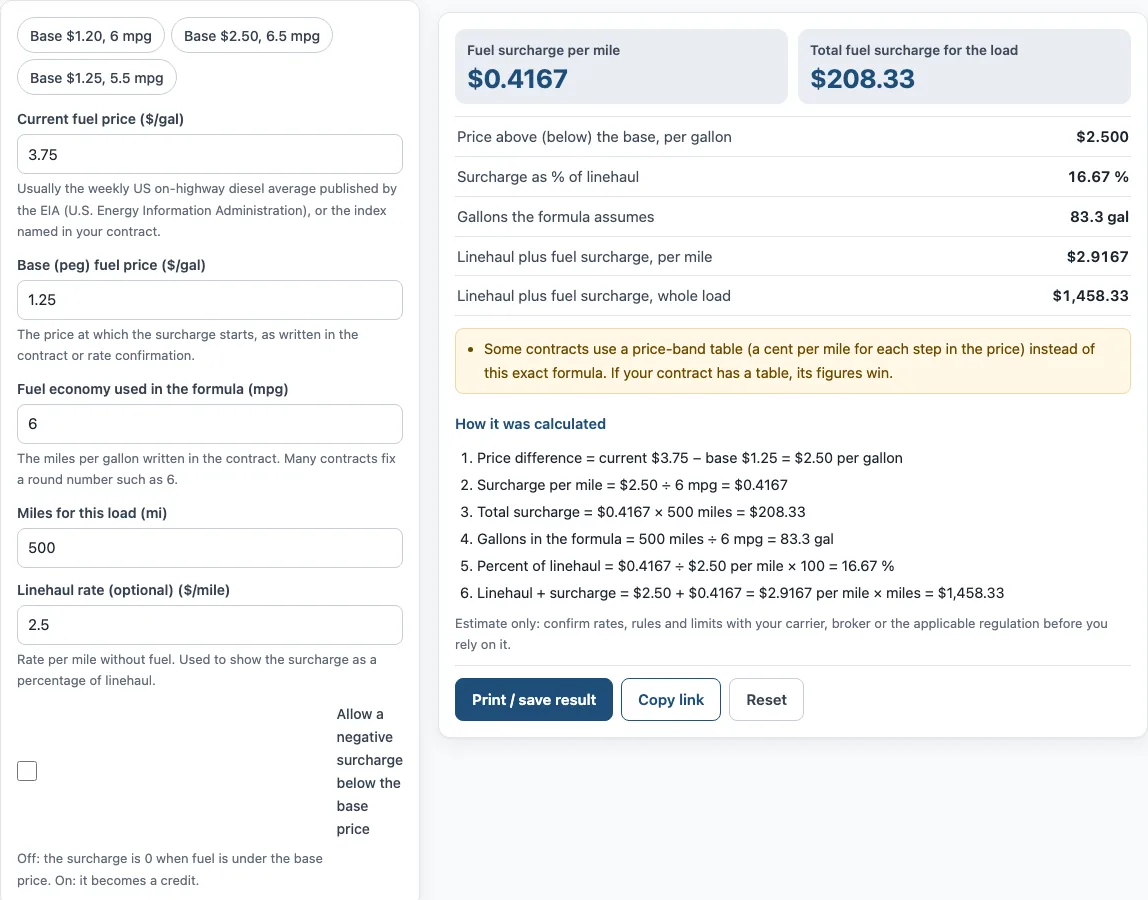
- With diesel at $3.75, a base of $1.25 and 6 mpg, the surcharge is $0.417 per mile, or $208.33 on a 500-mile load.
- With a linehaul rate of $2.50 per mile, the $0.417 surcharge is 16.67% of linehaul.
- The preset buttons use bases of $1.20, $2.50 and $1.25 with 6, 6.5 and 5.5 mpg.
- Most contracts use the weekly US on-highway diesel average from the EIA, but the tool does not fetch that price, so you type it in.
Sources: Fuel surcharge (Wikipedia) (checked 2026-10-15) · Gasoline and Diesel Fuel Update (U.S. Energy Information Administration) (checked 2026-10-15)
How to use the Fuel Surcharge Calculator
- Enter the Current fuel price ($/gal). Most contracts use the weekly US on-highway diesel average published by the EIA, or another index they name; type in that week’s price.
- Enter the Base (peg) fuel price ($/gal) from your contract or rate confirmation.
- Enter the Fuel economy used in the formula (mpg) written in the contract.
- Enter the Miles for this load (mi).
- Optional: enter the Linehaul rate ($/mile) to see the surcharge as a percentage of linehaul and the linehaul plus surcharge totals.
- Tick Allow a negative surcharge below the base price only if your contract allows a credit when fuel falls below the base.
- Read the results, then check How it was calculated to see each step with your numbers.
To start faster, use one of the preset buttons: “Base $1.20, 6 mpg”, “Base $2.50, 6.5 mpg”, or “Base $1.25, 5.5 mpg”. Reset restores the example values.
When your figures are ready, use Print / save result to print a one-page sheet with your inputs, results, calculation steps, and the date. Save it as a PDF from the print dialog. Copy link copies a link that reopens the same inputs, and the page address keeps your inputs after any change.
How do you figure a fuel surcharge?
Subtract the base price from the current diesel price, then divide the result by your miles per gallon. That gives the surcharge per mile. Multiply the per-mile figure by the trip miles to get the total surcharge for the load.
Standard per-mile fuel surcharge (FSC) = (current fuel price − base fuel price) ÷ miles per gallon. For example, with diesel at $3.75, a base of $1.25, and 6 mpg: ($3.75 − $1.25) ÷ 6 = $0.417 per mile. On a 500-mile load, that is $0.417 × 500 = $208.33.
If you have a linehaul rate, you can also express the surcharge as a percentage. Divide the FSC per mile by the linehaul rate per mile, then multiply by 100. With a linehaul rate of $2.50 per mile, the $0.417 surcharge is 16.67% of linehaul. Adding the surcharge to the linehaul rate gives the total rate per mile, and multiplying that by the miles gives the whole-load figure.
The tool prints each of these steps with your numbers, so you can check the arithmetic against your own paperwork.
What base fuel price should I use?
Use the base (peg) price written in your shipper or broker contract or your rate confirmation. The base is the fuel price at which the surcharge starts, so it is set by the agreement, not by today’s pump or diesel price. Today’s price belongs in the current fuel price box.
If the contract does not state a base, the surcharge cannot be worked out reliably from this formula. Ask the carrier or broker to confirm the base before you rely on the result. The base and the mpg figure together decide how much each cent of diesel change costs per mile, so a wrong base changes every number on the page.
Figuring a fuel surcharge as a percentage
Some shippers want the surcharge as a percentage of the linehaul instead of cents per mile. Figuring it is one more division: FSC per mile ÷ linehaul rate per mile × 100. Enter the linehaul rate and the tool shows this percentage next to the per-mile and per-load amounts.
Sources
The formula is the standard per-mile fuel surcharge; prices and the base (peg) come from your contract. Fuel price index:
Frequently asked questions
Where does the current diesel price come from?
Most US contracts use the weekly US on-highway diesel average published by the U.S. Energy Information Administration (EIA); the tool does not fetch it, so type in the price for the week that applies. If your contract names a different index, enter the price from that index in the current fuel price box instead.
Can a fuel surcharge be negative?
Under most contracts, the surcharge is zero when the current price is below the base. Some contracts allow a negative surcharge, which is a credit that reduces the rate. Tick the negative surcharge checkbox only if your contract says so.
What mpg should I enter?
Enter the miles per gallon written in the contract, not your truck’s real-world figure. Many contracts fix a round number, such as 6, so check the agreement first.
Can I use this calculator for Canadian loads?
The formula is the same arithmetic whatever the country. For a load priced on a different index, or in litres, convert to the same units as the base price and type that price into the current fuel price box.
Is the result the final surcharge I will be paid?
The result is an estimate. Confirm rates, rules, and limits with your carrier, broker, or the applicable regulation before you rely on it. If your contract uses a table of price bands, such as one cent per mile for every 5 or 6 cents of diesel price, the contract’s table takes priority over the formula.
Does the calculator store what I type?
The tool runs in your browser, and nothing you type is uploaded. Results may be used in quotes, invoices, and shipping plans without attribution.
Related tools
- Trucking cost per mile calculator: use it to see your full operating cost per mile alongside the fuel surcharge.
- IFTA calculator: use it when you need to work out fuel tax reporting across the states or provinces you drove through.
- Truck driver pay calculator: use it to estimate driver pay on a load, based on miles and pay terms.
- Axle weight calculator: use it to check how a load’s weight is spread across the axles before you dispatch.
- Bridge formula calculator: use it to check whether a vehicle’s axle spacing and weight meet the bridge formula limits.
- Truck loading calculator: use it to plan how freight fits in a trailer before you quote the load.