Knots to MPH Converter
Type a speed in knots, mph, km/h or m/s, or a distance in nautical miles, miles or km, and see every other unit at once.
This knots to mph converter changes a speed in knots into miles per hour, and it works the other way too. It also gives kilometres per hour, metres per second and feet per second, so one entry answers every speed question at once. A second mode converts distances between nautical miles, statute miles, kilometres, metres and feet, which covers “nautical miles to miles” as well.
Use it for ship and boat speeds, wind and current speeds, and flight or voyage planning. The tool is free, runs in your browser and needs no sign-up. The conversion factors are exact definitions, not approximations, and the page shows each step with your numbers.
How to use the knots to mph converter
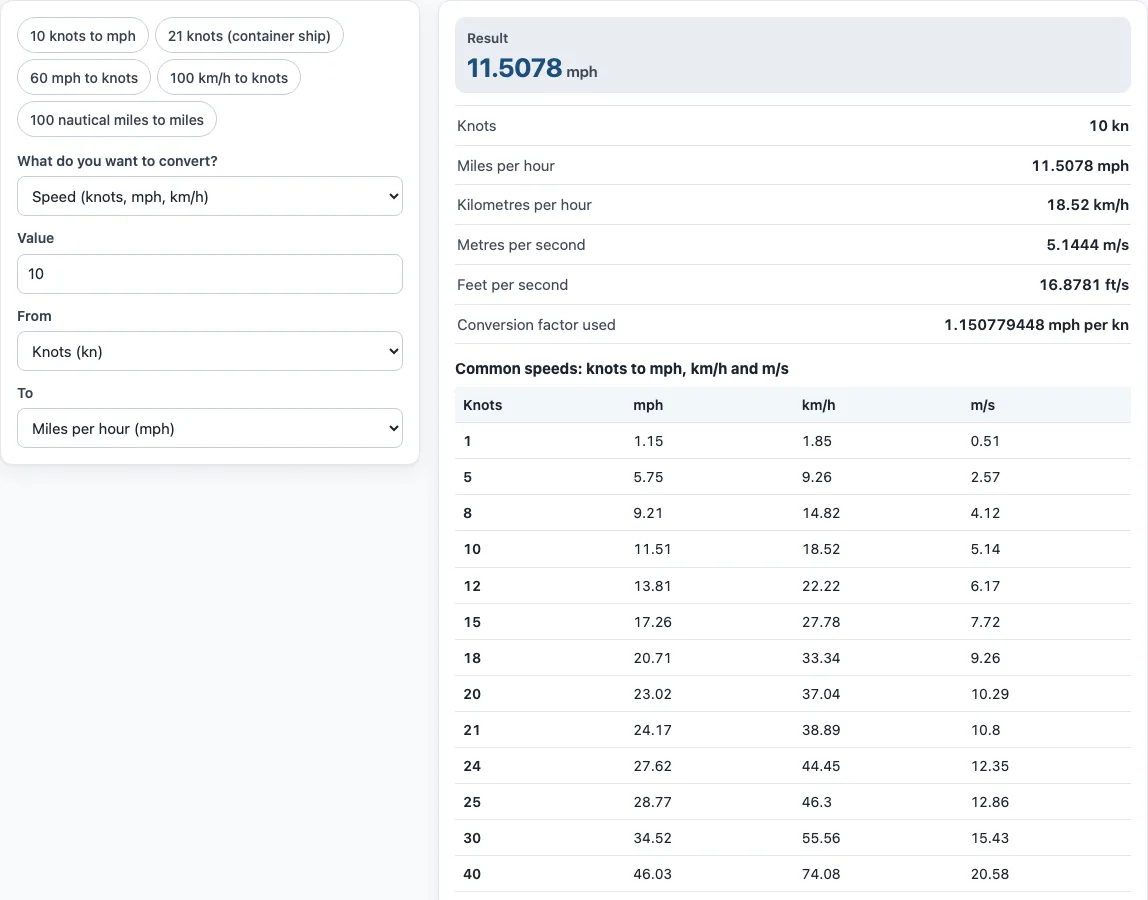
- Under What do you want to convert?, choose “Speed (knots, mph, km/h)” or “Distance (nautical miles, miles, km)”.
- Type your number in Value. Decimals are fine, for example 21.5.
- Open From and pick the unit you have, such as “Knots (kn)”.
- Open To and pick the unit you want, such as “Miles per hour (mph)”. The tool starts with knots to mph.
- Read the large Result. Below it the page lists the same value in every other unit, plus the conversion factor used.
- Check How it was calculated for the formula filled in with your numbers.
- Scroll to the table of common speeds or distances for quick reference values, such as 21 knots in mph or 100 nautical miles in miles.
The starting values are 10 knots to mph. When you change What do you want to convert? the other menus change with it, so pick the units again.
You can also click a preset: “10 knots to mph”, “21 knots (container ship)”, “60 mph to knots”, “100 km/h to knots” or “100 nautical miles to miles”. Copy link copies a link that reopens the same inputs, Print / save result makes a one-page sheet with the date, and Reset restores the starting values.
How do you convert knots to mph?
Multiply the number of knots by 1.150779 to get miles per hour. A knot is one nautical mile per hour, and a nautical mile is longer than a statute mile, so the mph figure is always larger than the knots figure. For example, 10 knots is 11.5078 mph, and 21 knots is 24.1664 mph.
The factor is exact: a nautical mile is 1,852 m and a statute mile is 1,609.344 m, so 1 knot = 1,852 ÷ 1,609.344 = 1.150779 mph. The tool uses the full-precision value, not the rounded one.
How many mph is 1 knot, and how many knots is 1 mph?
One knot is 1.150779 mph, which is also 1.852 km/h, 0.514444 m/s and 1.687810 ft/s. In the other direction, 1 mph is 0.868976 knots, so 60 mph is 52.1386 knots. To go from km/h to knots, divide by 1.852: 100 km/h is 53.9957 knots.
How do you convert nautical miles to miles?
Multiply the nautical miles by 1.150779 to get statute miles, or by 1.852 to get kilometres. So 100 nautical miles is 115.0779 miles or 185.2 km. To go back, divide miles by 1.150779 (1 mile = 0.868976 nautical miles) or kilometres by 1.852 (1 km = 0.539957 nautical miles).
Choose “Distance (nautical miles, miles, km)” in the first menu to do this directly. The “100 nautical miles to miles” preset shows the example.
What is the difference between a knot and mph?
Both measure speed, but they use different miles. A knot is one nautical mile per hour, and the nautical mile is tied to the Earth: it was first defined as one minute of latitude. The international nautical mile is exactly 1,852 m. Miles per hour uses the statute mile of 1,609.344 m, so a knot is about 15 % faster than 1 mph.
How fast is a container ship in knots and mph?
Many container lines slowed their voyage speed to about 21 knots in the early 2010s when fuel prices rose, down from earlier top speeds of 25 knots or more. At 21 knots a ship covers 24.17 mph, or 38.89 km/h, which is about 504 nautical miles a day.
Sources
Definitions used by this tool (checked October 2026):
- Knot (unit), Wikipedia: 1 knot = 1 nautical mile per hour = exactly 1.852 km/h, about 1.151 mph
- Nautical mile, Wikipedia: the international nautical mile is exactly 1,852 m; the US adopted it in 1954 and the UK in 1970
- NIST Special Publication 811: 1 foot = 0.3048 m and 1 statute mile = 1,609.344 m
- Container ship, Wikipedia: economical voyage speed of about 21 knots compared with earlier top speeds of 25 or more
Frequently asked questions
What is the formula for knots to mph?
mph = knots × 1.150779. For the reverse, knots = mph × 0.868976 (or mph ÷ 1.150779).
Is a knot faster than 1 mph?
Yes. One knot is 1.150779 mph, so a speed in knots is a smaller number than the same speed in mph, and a boat doing 20 knots is doing 23.02 mph.
Why do ships use knots instead of mph?
A knot is one nautical mile per hour, and a nautical mile matches one minute of latitude on a chart. That makes distance and speed easy to read directly from a chart, which is why ships, boats and aircraft use it. Wikipedia notes that the knot is also used in meteorology.
Is a nautical mile the same as a mile?
No. A nautical mile is 1,852 m (about 6,076 ft), and a statute mile is 1,609.344 m (5,280 ft). One nautical mile is 1.150779 statute miles.
Does “kt” mean the same as “kn”?
Yes. Both are symbols for knots. The ISO symbol is kn, while kt is common in aviation. The tool accepts either meaning because they are the same unit.
How do I convert knots to km/h?
Multiply by 1.852, because a knot is exactly 1.852 km/h. For example, 12 knots is 22.224 km/h.
Are the results exact?
The conversion factors are exact definitions, based on 1 nautical mile = 1,852 m and 1 statute mile = 1,609.344 m. The displayed numbers are rounded; the page shows up to four or six decimals.
Can I use the results in my work?
Yes. You may use the results in commercial work such as voyage plans, quotes and reports without attribution. The conversion is exact, but speeds through water and over the ground differ, so check which one your document needs.
Related tools
- Boat travel time calculator: use it to turn a distance and a speed into a travel time and arrival.
- Sea distance calculator: use it to measure a port-to-port distance in nautical miles.
- Shipping container dimensions: use it to look up container sizes and weights.
- CBM calculator: use it to work out cargo volume in cubic metres.
- All logistics calculators: use it to browse every calculator on this site.