Landed Cost Calculator
Enter the unit price, quantity and import costs to get the total and per-unit landed cost and a selling price for your margin.
The landed cost calculator works out the total cost of getting a product from your supplier to your door, then divides that total by the number of units to give a cost per unit. You enter the supplier price, exchange rate, freight, insurance, duty, fees and VAT, and it shows the landed cost, the customs value, the import duty and VAT, and the selling price needed for your target margin. It is a free online tool that runs in your browser. There is no account or sign-up, and nothing you type is uploaded.
Use it as an import cost calculator for a purchase order before you place it.
At a glance
Landed Cost Calculator is a free browser tool that adds supplier price, freight, insurance, duty, fees and non-recoverable VAT to return the total and per-unit landed cost, plus the selling price for a target gross margin.
- Landed cost per unit = total landed cost ÷ quantity, and the total includes goods, freight, insurance, duty, customs fees and other costs.
- In the example, 5,831.78 ÷ 1,000 units gives 5.8318 per unit, which is 29.6% above the goods cost.
- The import VAT in the example is 1,076.36, charged at 20% on 5,125.50 + 256.28.
- A selling price is landed cost ÷ (1 − margin), so 5.8318 ÷ (1 − 0.40) = 9.7196 per unit at a 40% margin.
- A 40% gross margin is a 66.67% markup on cost, which is a different figure from the margin.
Sources: Landed cost (Wikipedia) (checked 2026-10-15)
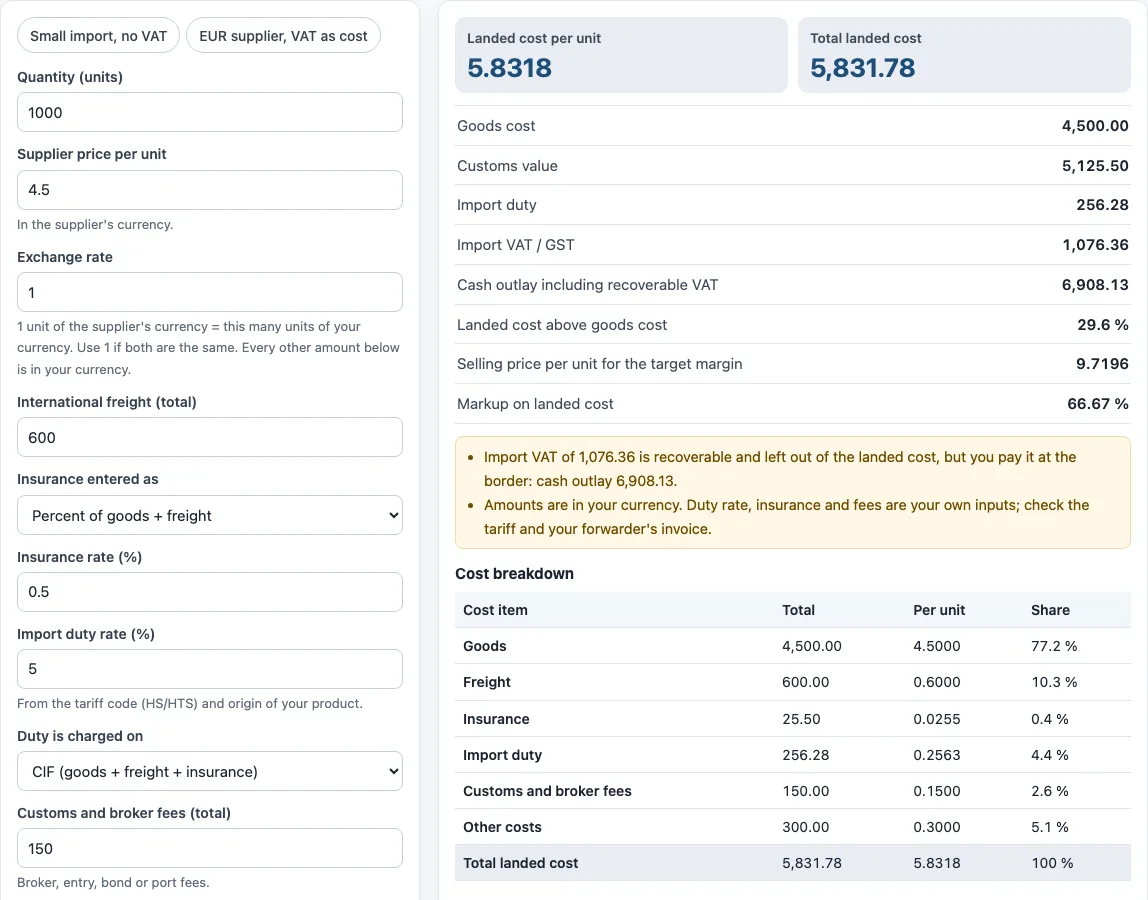
How to use the Landed Cost Calculator
- Enter the Quantity in units.
- Enter the Supplier price per unit in the supplier’s currency.
- Enter the Exchange rate: how many units of your currency equal 1 unit of the supplier’s currency. Use 1 if both currencies are the same.
- Enter the International freight (total) in your currency.
- Choose how Insurance is entered, as a percentage of goods + freight or as a fixed amount, then fill in the Insurance rate (%) or Insurance (total).
- Enter the Import duty rate (%) from the tariff code (HS/HTS) and origin of your product.
- Choose the Duty is charged on basis: CIF (goods + freight + insurance) or FOB (goods only).
- Enter the Customs and broker fees (total) and the Other costs (total), such as inland delivery, storage, inspection or packaging.
- Enter the VAT / GST rate (%). Use 0 if no import VAT applies.
- Tick VAT is recoverable if you can reclaim it. The VAT then leaves the cost but still appears as cash paid at the border.
- Enter your Target gross margin (%) to see the selling price per unit.
Preset buttons for “Small import, no VAT” and “EUR supplier, VAT as cost” fill in common setups. Under the result, “How it was calculated” lists each step with your numbers. “Print / save result” creates a one-page sheet with your inputs, results and the date, which you can save as a PDF from the print dialog. “Copy link” copies a link that reopens the same inputs, and “Reset” restores the example values.
How do you calculate landed cost?
Add every cost of getting the goods to your door. These are the product cost, international freight, insurance, import duty, customs and broker fees, and other costs such as inland delivery. Import VAT or GST is added only when you cannot reclaim it. Divide the total by the quantity to get the landed cost per unit.
What is included in landed cost?
Landed cost includes the goods, the freight, insurance, import duty, customs and broker fees, and any other costs such as storage, inspection or packaging. Import VAT or GST is included only when it is not recoverable. The duty is calculated on a customs value, which is either CIF (goods, freight and insurance) or FOB (goods only), depending on the rule that applies to your product.
Is VAT part of landed cost?
VAT is part of landed cost only when you cannot get it back. Import VAT or GST is charged on the customs value plus the duty. If you can reclaim it, it is left out of the cost, but you still pay it at the border, so it appears as cash outlay. In the worked example, the import VAT is 1,076.36, which is charged at 20% on 5,125.50 + 256.28, and the cash outlay including recoverable VAT is 6,908.13.
How do I price a product from its landed cost?
Divide the landed cost per unit by one minus your target gross margin. Margin is a share of the selling price, not of the cost. In the example, a 5.8318 landed cost at a 40% margin gives 5.8318 ÷ (1 − 0.40) = 9.7196 per unit. That price is a 66.67% markup on cost, which is a different figure from the 40% margin.
What is the landed cost formula per unit?
Landed cost per unit = total landed cost ÷ quantity. The total landed cost is goods + freight + insurance + duty + customs fees + other costs + non-recoverable VAT. In the example, 5,831.78 ÷ 1,000 units = 5.8318 per unit. The landed cost is 29.6% above the goods cost, which is (5,831.78 − 4,500.00) ÷ 4,500.00.
Sources
No duty, VAT or exchange rates are built in; enter the ones for your shipment. Official rate lists:
Frequently asked questions
Is this an import cost calculator for cars too?
Yes, the same inputs apply to a car import, as long as you enter the car’s price, freight, insurance, duty rate and VAT. Car imports often have extra taxes or registration charges, so enter them under Other costs or check them with your broker.
Are the results exact?
The results are estimates. Confirm rates, rules and limits with your carrier, broker or the applicable regulation before you rely on them.
Can I use the results in quotes or invoices?
Yes. The results may be used in commercial work, such as quotes, invoices and shipping plans, without attribution.
What happens if my supplier quotes in a different currency?
Enter the supplier price in the supplier’s currency and set the exchange rate to how many units of your currency equal one unit of theirs. All other amounts should be in your currency.
Does the tool save my data?
Calculations run in your browser, and nothing you type is uploaded. The page address keeps your inputs, so you can reopen the same figures with the copy link.
Why is landed cost higher than the supplier price?
The supplier price covers only the goods. Freight, insurance, duty, customs fees and delivery are added on the way to your door, and in the default example they put the landed cost 29.6% above the goods cost.
Related tools
- Import duty calculator: use this to check the duty rate for your tariff code and origin before you enter it here.
- Incoterms chart: use this to see which costs your supplier covers and which fall on you, so you know what to include.
- CBM calculator: use this to work out the volume of your cargo when freight is priced by cubic metre.
- Chargeable weight calculator: use this to find the billable weight when a carrier charges by volumetric or actual weight.
- Shipping container dimensions: use this to compare container sizes when planning a full container load.