Freight Linear Feet Calculator
Enter the number and size of pallets to get the linear feet of trailer they use.
The freight linear feet calculator estimates how many feet of trailer floor a shipment takes up, measured along the length of the trailer. Enter the number of pallets, their size and whether they stack, and the tool shows the linear feet, the loading metres and how much of a 53 ft or 48 ft trailer the load fills.
LTL carriers use linear feet to price large shipments that take up space without much weight. Seeing this number before you request a quote helps you understand the cost basis. The calculator tests both ways of loading each pallet and keeps the layout that uses less floor.
It runs in your browser and is free. Nothing you type is uploaded, and there is no account or sign-up. Results are estimates, so confirm rates, rules and limits with your carrier, broker or the applicable regulation before you rely on them.
At a glance
Freight Linear Feet Calculator estimates how many feet of trailer floor a pallet shipment takes, showing linear feet, loading metres and the share of a 53 ft or 48 ft trailer.
- The calculator is free, runs in your browser, and needs no account or sign-up.
- It tests both pallet loading layouts and uses the one that takes fewer linear feet.
- Typical trailer inside width is 98 in (245 cm) for a US dry van.
- The European loading-metre rule uses a 2.4 m (240 cm) trailer width.
- A full European trailer is 13.6 m long.
- Results are estimates; confirm figures with your carrier, broker or the applicable regulation.
Sources: Less than truckload shipping (Wikipedia) (checked 2026-10-15) · Loading meter (TIMOCOM Transport Lexicon) (checked 2026-10-15)
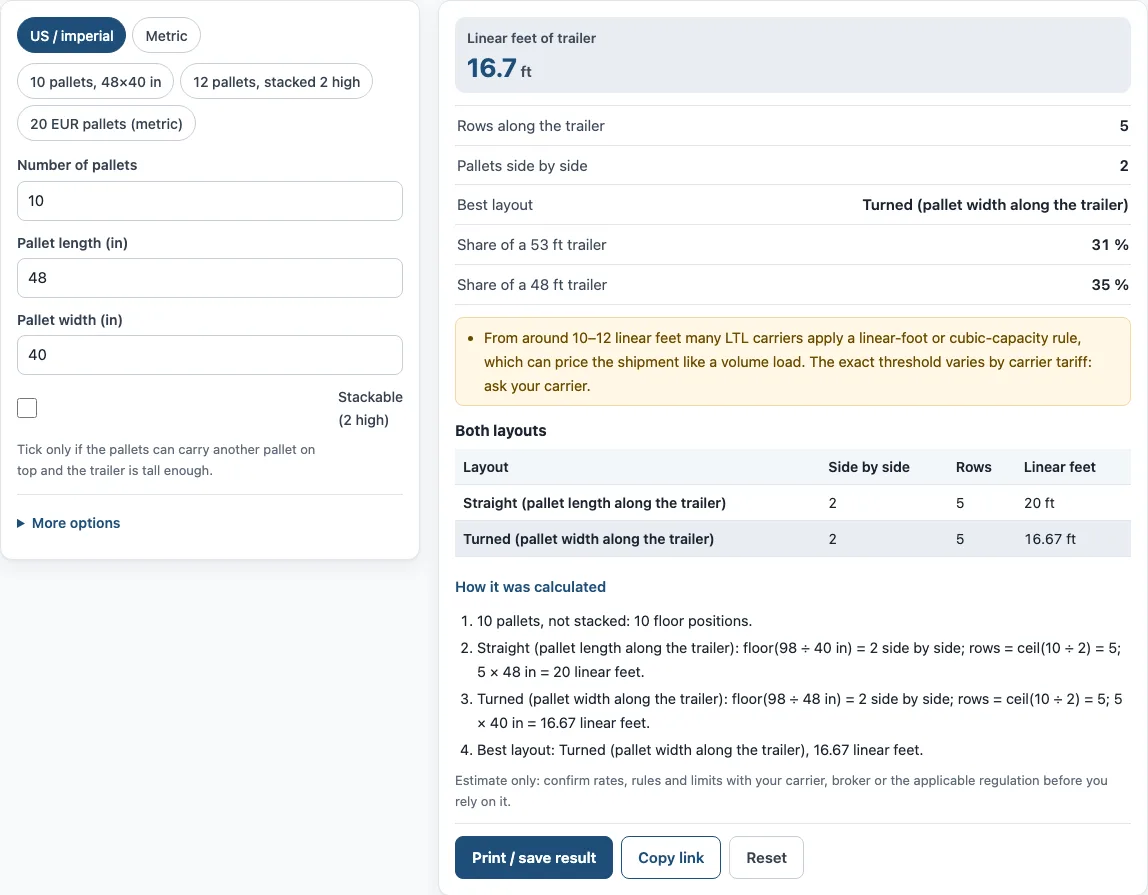
How to use the Linear feet freight calculator
- Choose a unit system with the switch: “Metric” or “US / imperial”. Typed values are converted when you switch.
- Enter the Number of pallets.
- Enter the Pallet length and Pallet width, in cm or in to match your unit choice. For example, a common US pallet is 48 × 40 in.
- Tick Stackable (2 high) only if the pallets can carry another pallet on top and the trailer is tall enough.
- Open More options and check the Trailer inside width. Typical values are 98 in (245 cm) for a US dry van and 2.4 m (240 cm) for the European loading-metre rule.
- Read the results: Linear feet of trailer, Loading metres (LDM), Linear metres of trailer, Rows along the trailer, Pallets side by side, Best layout, and the share of a 53 ft, 48 ft or 13.6 m trailer. The Both layouts table compares the two ways of loading.
To start faster, use a preset button: “10 pallets, 48×40 in”, “12 pallets, stacked 2 high” or “20 EUR pallets (metric)”.
Under the result, “How it was calculated” lists each step with your numbers. “Print / save result” creates a one-page sheet with the inputs, results, steps and date; choose “Save as PDF” in the print dialog to keep a copy. “Copy link” copies a link that reopens the same inputs, and the page address keeps your inputs after any change. “Reset” restores the example values.
How do you calculate linear feet for freight?
Linear feet is the length of trailer floor a shipment takes, measured along the trailer. You find it in three steps: work out how many pallets fit across the trailer, divide the number of pallet stacks by that figure and round up to get rows, then multiply the rows by the pallet length along the trailer and divide by 12.
In short: pallets per row = how many fit across the trailer (about 100 in inside a 53 ft dry van); rows = stacks ÷ pallets per row, rounded up; linear feet = rows × pallet length along the trailer ÷ 12.
Take ten 48 × 40 in pallets, not stacked. Loaded turned, with 40 in along the trailer, two fit across, which gives 5 rows. That is 5 × 40 in = 16.67 linear feet. Loaded straight, with 48 in along the trailer, the same load takes 20 feet. The tool uses the smaller figure.
How many linear feet does a pallet take?
A pallet alone in its row takes its length along the trailer divided by 12. A 48 in pallet loaded lengthwise therefore takes 4 linear feet. Pallets that fit side by side share a row, so each one takes only its part of that row.
What is the linear foot rule in LTL?
The linear foot rule is a pricing method some less-than-truckload (LTL) carriers use. Once a shipment takes up enough trailer floor, it is charged for the space it takes, not only for its weight. The trigger is often quoted at around 10 to 12 linear feet, but each carrier’s rules tariff sets the exact threshold and charge.
What is a loading metre?
A loading metre (LDM) is the European measure of how much trailer floor a load takes, in metres. You calculate it as pallet length × pallet width, in metres, ÷ 2.4 m, the standard trailer width. A EUR pallet of 1.2 × 0.8 m is 0.4 LDM, so 20 EUR pallets make 8 LDM. A full trailer is 13.6 m long.
Do stackable pallets reduce linear feet?
Yes. Stacking two pallets high halves the number of stacks, and linear feet follow the stacks. Twelve pallets stacked 2 high make 6 stacks; loaded turned, two across, that is 3 rows × 40 in = 10 linear feet. The same 12 pallets unstacked take 20 linear feet. Tick Stackable only when the pallets can safely carry another on top and the trailer is tall enough.
Sources
Data and rules used by this tool (checked October 2026):
Frequently asked questions
What trailer width should I enter?
Use about 100 in for a US 53 ft dry van (Hale Trailer’s published inside width), or 2.4 m (240 cm) for the European loading-metre rule. If your carrier gives a different inside width, enter that figure instead.
Can I use the results in a quote or invoice?
Yes. Results may be used in commercial work such as quotes, invoices and shipping plans without attribution. Because the tool gives an estimate only, confirm final figures with your carrier, broker or the applicable regulation.
Does the calculator upload what I type?
No. The calculator runs in your browser, and nothing you type is uploaded. You do not need an account or sign-up to use it.
Can I switch between metric and imperial after entering values?
Yes. Use the unit switch, and your typed values are converted to the new unit system. You can then check the same load in whichever units your carrier uses.
Why does the tool show two layouts?
A pallet can go into the trailer with its long side or its short side along the trailer. The tool works out both, shows them in the Both layouts table and uses the one that takes fewer linear feet. Ask your carrier if the freight must be loaded one way.
Related tools
- Pallet calculator: use it to work out how many pallets fit a given space before you calculate linear feet.
- Pallets in a container: use it when your freight goes in a shipping container instead of a trailer.
- Container loading calculator: use it to check how a full load of boxes or pallets fits inside a container.
- Shipping container dimensions: use it to look up internal sizes when you plan a container load.
- Truck loading calculator: use it to plan how cargo fills a truck once you know the trailer size.
- Warehouse space calculator: use it to estimate how much storage floor your pallets will need.
- Trucking cost per mile calculator: use it to estimate the running cost of a trucking route.
- Fuel surcharge calculator: use it to estimate the fuel surcharge that may be added to a freight bill.