Moving Truck Size Calculator
Choose your home size or list your furniture and boxes to estimate the volume and the moving truck size you need.
The Moving Truck Size Calculator recommends a rental truck size for your move. Pick your home size to see which truck U-Haul suggests for it, or list your furniture and boxes to estimate the cargo volume and find the smallest truck that holds it. It also works as a moving boxes calculator, since standard box sizes are in its item list.
The tool runs in your browser, is free, and needs no account or sign-up. Nothing you type is uploaded. Truck figures are U-Haul’s published specifications and item volumes come from a published household goods cube sheet, so the result is a planning figure: check the final choice with your rental company before you book.
At a glance
Moving Truck Size Calculator is a free browser tool that estimates your cargo volume from a home size or item list and recommends the smallest suitable U-Haul truck.
- Free to use, runs in the browser, and needs no account or sign-up.
- Truck volumes: cargo van 246 ft³, 10 ft 402 ft³, 15 ft 764 ft³, 20 ft 1,016 ft³, 26 ft 1,682 ft³.
- Warns when the load would fill more than 90% of the chosen truck.
- Item volumes come from the Alaska household goods cube sheet; results are planning estimates.
- Loading allowance defaults to 0% unless a figure is entered.
Sources: Moving company (Wikipedia) (checked 2026-10-15) · Moving truck rentals (U-Haul) (checked 2026-10-15)
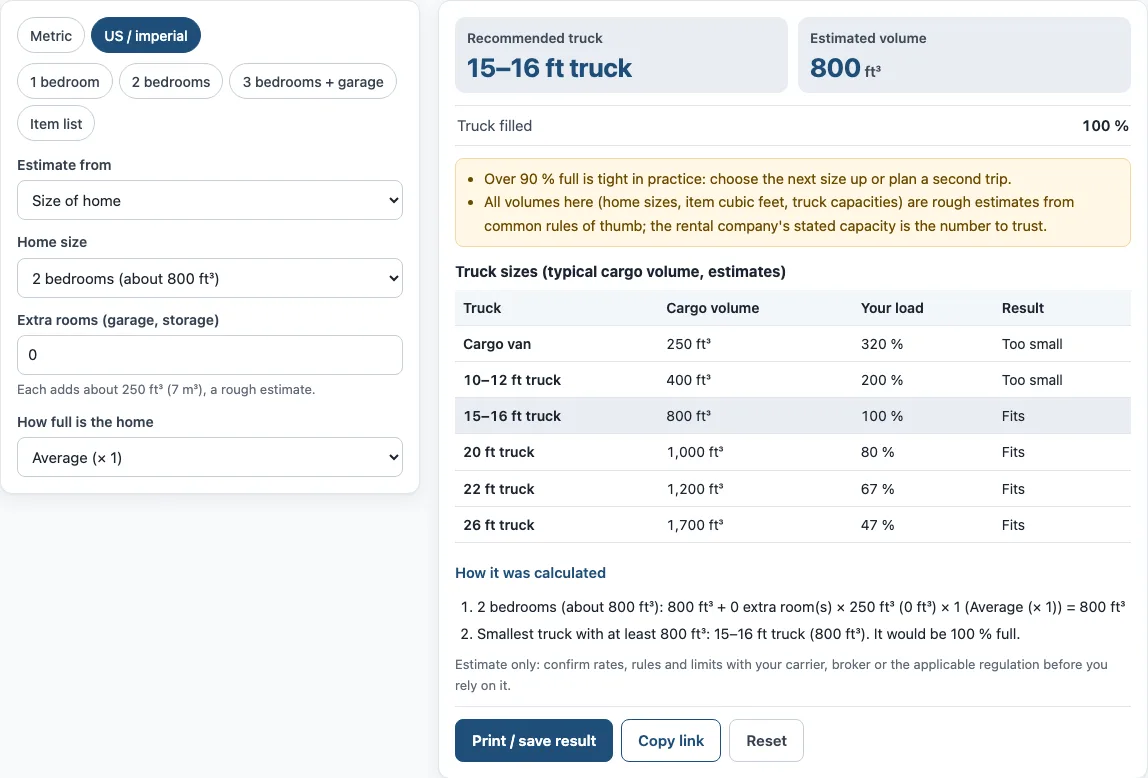
How to use the Moving Truck Size Calculator
- Choose a unit with the switch: “Metric” or “US / imperial”. Any values you have typed are converted when you switch.
- Under “Estimate from”, pick “Size of home” or “List of items”.
- For “Size of home”, choose a Home size from studio to 4 bedrooms or more. The result shows the truck U-Haul lists as suited to that home.
- For “List of items”, click “+ Add an item” for each line. Pick an Item, enter the Quantity, and for “Other” enter the Volume each in m³ or ft³. Click × to remove a line.
- With “List of items”, you can set a Loading allowance (%) for gaps and awkward shapes. It is 0 unless you enter a figure.
- Read the results: Recommended truck, and for an item list also Estimated volume and Truck filled. Compare them with the truck sizes table, and open “How it was calculated” to see each step with your numbers.
You can start from the preset buttons: “1 bedroom”, “2 bedrooms”, “3 bedrooms”, or “Item list”. “Reset” restores the example values. “Copy link” gives you a link that reopens the same inputs, and “Print / save result” makes a one-page sheet with your inputs, results, calculation steps, and the date. To keep a PDF, choose save as PDF in the print dialog.
What size moving truck do I need?
Choose the smallest truck whose cargo volume is at least the volume of your belongings. U-Haul publishes these volumes for its trucks: cargo van 246 ft³, 10 ft truck 402 ft³, 15 ft truck 764 ft³, 20 ft truck 1,016 ft³ and 26 ft truck 1,682 ft³. The tool picks the smallest that fits your item list and warns you when the load would fill more than 90% of it.
Other rental companies’ trucks of the same nominal length hold different volumes, so use the rental company’s own figure before you book.
How many cubic feet is a 2 bedroom apartment?
There is no fixed figure, because it depends on what you own. U-Haul lists its 15 ft truck (764 ft³) for 1 to 2 bedroom homes and its 20 ft truck (1,016 ft³) for 2 to 3 bedroom homes, so a 2 bedroom move usually lands between those two sizes. The tool shows both and tells you when to take the larger one.
For your own figure, switch to “List of items”. The item volumes are taken from the Alaska Department of Public Safety household goods cube sheet: for example a 3-cushion sofa is 50 ft³, a queen bed with frame 65 ft³, a dresser 25 ft³ and a refrigerator of 11 ft³ or more 50 ft³.
How do I estimate the volume of my furniture?
Add up the volume of each piece, multiplied by its quantity. The tool does this for the items in its list, so you only need to count how many of each you have. Cube-sheet volumes are averages for each kind of item, so measure anything unusually large.
For an item that is not on the list, measure its length, width, and height, and multiply the three together. In feet, convert each measurement from inches by dividing by 12, or multiply the inches and divide by 1,728. In metres, multiplying the three measurements gives m³ directly. Enter the result under “Other” with the matching unit.
Is a 26 ft truck enough for a 4 bedroom house?
Often, but not always. U-Haul lists its 26 ft truck (1,682 ft³, 12,859 lb maximum load) as suited to 3 to 4 bedroom homes. A large or very full 4 bedroom house can need more than that, so list your items: if the total is over 1,682 ft³, the tool shows how many 26 ft loads you need.
Sources
Data and rules used by this tool (checked October 2026):
Frequently asked questions
What if my move is bigger than 1,682 ft³?
Above 1,682 ft³, a single U-Haul 26 ft truck is not enough. You will need two trucks, two trips, or a moving container. Use the Estimated volume figure to decide which option suits your move.
Why does the tool warn me when a truck is more than 90% full?
A truck that is nearly full leaves little room for gaps, awkward shapes, or items that shift during the drive. The warning reminds you to consider a larger truck or to reduce the load.
Can I use these results for quotes or shipping plans?
Yes. Results may be used in commercial work such as quotes, invoices, and shipping plans, without attribution. Confirm rates, rules, and limits with your carrier, broker, or the applicable regulation before you rely on them.
How accurate is the estimate?
The truck volumes are the rental company’s published figures and the item volumes are averages from a published cube sheet, so the result is a planning estimate, not a measurement. Measure large items and check the truck’s stated capacity with the rental company.
Should I count boxes in the item list?
Yes. Boxes often take as much room as the furniture. Add lines for small (1.5 ft³), medium (3 ft³), large (4.5 ft³) and small wardrobe boxes (11 ft³) with your best count.
Related tools
- Truck loading calculator: use it to plan how items fit inside the truck once you have chosen a size.
- Axle weight calculator: use it to check how a load is spread across a truck’s axles.
- Bridge formula calculator: use it to check whether a loaded vehicle meets bridge weight limits.
- Trucking cost per mile calculator: use it to estimate what a long-distance haul costs per mile.
- Fuel surcharge calculator: use it to work out a fuel surcharge on a freight bill.
- IFTA calculator: use it to work out fuel tax across the states or provinces you drive through.
- Truck driver pay calculator: use it to estimate pay for a driving job.