Shipping Container Dimensions
Pick a container type to see its inside, outside and door measurements, volume and payload, and check whether your cargo fits.
This free shipping container dimensions tool shows the inside size, capacity, tare weight and payload for 10 container types, from the 20 ft standard to the 45 ft high cube, and checks whether your cargo fits. It runs in your browser, so nothing you type is uploaded, and it needs no account or sign-up.
Use it to compare standard shipping container sizes and dimensions before you plan a load, or to confirm the size of the shipping container you are quoting for. Choose a container type and the results update straight away. You can also enter your own cargo to test the fit. Each figure is one published specification (SeaCube’s spec sheets for standard, high cube and reefer boxes; DSV for 45 ft, open top and flat rack), so check the final limits with your carrier before you commit.
At a glance
Shipping Container Dimensions is a free browser tool that lists inside size, capacity, tare, gross weight and payload for 10 container types from 20 ft to 45 ft high cube, and checks whether a cargo piece fits inside, through the door and within payload.
- A 20 ft standard container has a published inside size of 5.898 × 2.352 × 2.393 m.
- A 40 ft high cube has a published inside height of 2.698 m and a door opening of 2.585 m high.
- A 40 ft high cube has a 32,500 kg maximum gross and a 3,750 kg tare, giving a payload of 28,750 kg.
- Capacity is about 67.7 m³ for a 40 ft standard and about 76.4 m³ for a 40 ft high cube.
- The fit check tests one piece of cargo against the inside size, the door and the payload, and does not count how many pallets fit.
Sources: Intermodal container (Wikipedia) (checked 2026-10-15) · Dry shipping containers (SeaCube Containers) (checked 2026-10-15)
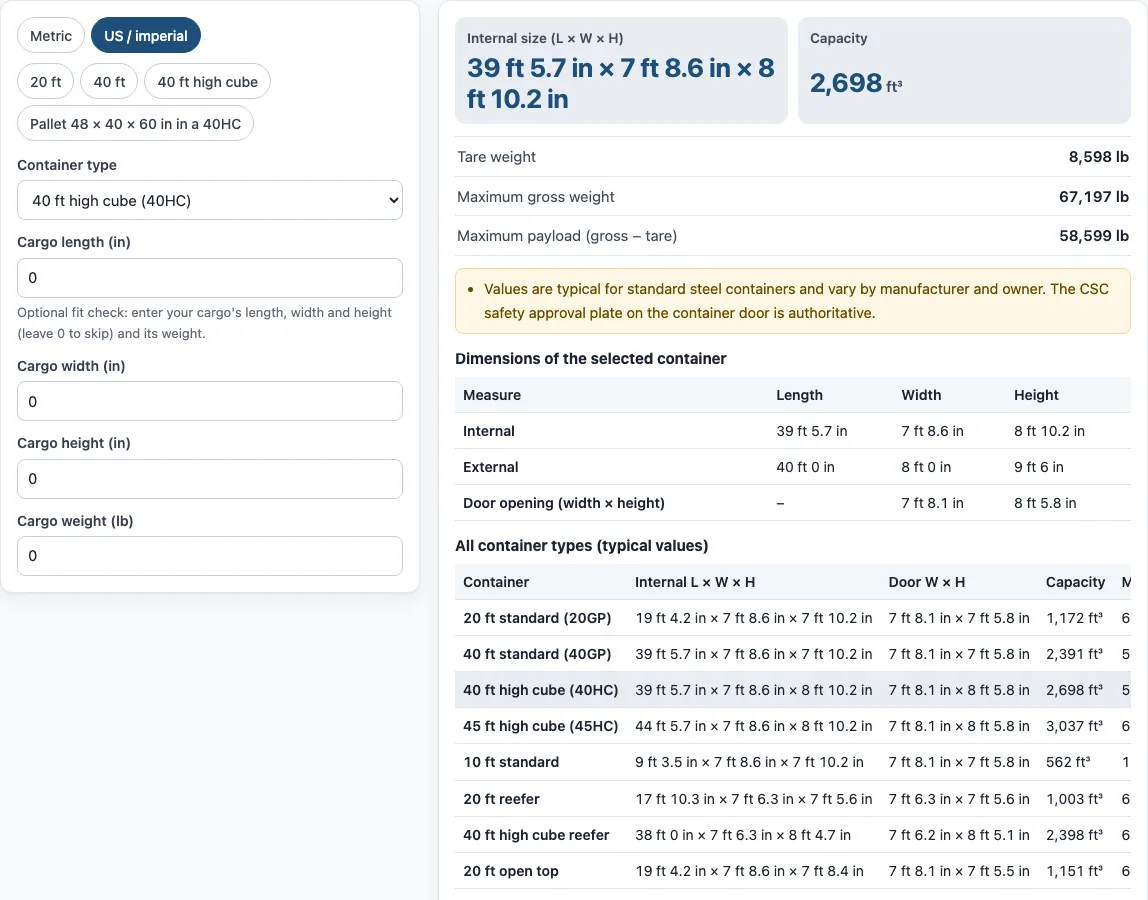
How to use the shipping container dimensions tool
- Set the Unit switch to “Metric” or “US / imperial” to read the dimensions in metres or in feet and inches. Any values you have typed convert when you switch.
- Open Container type and pick an option, such as “20 ft standard (20GP)” or “40 ft high cube (40HC)”.
- Read the results: Internal size (L × W × H), Capacity, Tare weight, Maximum gross weight and Maximum payload (gross − tare).
- To test a load, enter the Cargo length, Cargo width, Cargo height and Cargo weight. Leave a value at 0 to skip it.
- Check the three answers: Fits inside, Passes through the door and Weight within payload.
- Compare options in the All container types (published values) table, or review the Dimensions of the selected container table.
The preset buttons fill in common setups: “20 ft”, “40 ft”, “40 ft high cube” and “Pallet 48 × 40 × 60 in in a 40HC”. Under the result, How it was calculated lists each formula step with your numbers. Print / save result produces a one-page sheet with your inputs, results, steps and the date; choose “Save as PDF” in the print dialog to keep a copy. Copy link gives you a link that reopens the same inputs, and Reset restores the example values.
What are the dimensions of a 20 ft shipping container?
A standard 20 ft container is 20 ft (6.058 m) long and 8 ft (2.438 m) wide on the outside. Its inside size on SeaCube’s published spec sheet is 5.898 × 2.352 × 2.393 m, which is 19 ft 4 in × 7 ft 8.6 in × 7 ft 10 in.
Manufacturers vary the inside measurements slightly, so treat these as representative values. The tool’s “20 ft standard (20GP)” option shows the exact figures it uses for that type.
What are the dimensions of a 40 ft shipping container?
A standard 40 ft container is 40 ft (12.192 m) long and 8 ft wide on the outside, with a standard outside height of 8 ft 6 in (2.591 m). Its inside size on SeaCube’s published spec sheet is 12.032 × 2.352 × 2.393 m, which gives a capacity of about 67.7 m³ (2,391 ft³).
The high cube version, the 40 ft high cube (40HC), has the same length and width inside but is taller. That extra height gives it about 76.4 m³ (2,698 ft³) of capacity.
How tall is a high cube container?
A high cube container has an outside height of 9 ft 6 in (2.896 m), which is 1 ft taller than a standard box. On a 40 ft high cube, the published inside height is 2.698 m, or 8 ft 10.2 in.
The extra inside height matters for tall or stacked cargo. The door opening is also taller on high cubes, at 2.585 m.
What is the inside width of a shipping container?
The inside width of a standard 20 ft or 40 ft container is 2.352 m on SeaCube’s spec sheets, or 7 ft 8.6 in. The outside width is 8 ft (2.438 m), so the corrugated steel walls take up about 43 mm (1.7 in) on each side.
Use the inside width when checking whether a pallet or crate fits across the box. The tool’s Fits inside result compares your cargo width with this internal figure, and it allows the length and width to be swapped.
How much weight can a shipping container hold?
Payload is the maximum weight of cargo a container can carry. It equals the maximum gross weight minus the tare weight, which is the empty weight of the container itself.
On SeaCube’s published spec sheets, a 20 ft container has a 30,480 kg maximum gross and a 2,140 kg tare, giving a payload of 28,340 kg. A 40 ft standard has a 32,500 kg maximum gross and a 3,530 kg tare, so its payload is 28,970 kg. A 40 ft high cube has a 32,500 kg maximum gross and a 3,750 kg tare, giving 28,750 kg. Older and other owners’ boxes can be rated lower, for example 30,480 kg gross on a 40 ft.
The CSC safety approval plate on the container door states the real maximum gross and tare for that box. Those figures take priority over the published values in the tool.
How big is the container door opening?
On standard containers, the door opening is about 2.340 m wide and 2.280 m high. On high cube containers, the opening is about 2.585 m high, with the same width.
Your cargo must be small enough to pass through this opening, even if it fits inside the box. The tool’s Passes through the door result checks this, and it allows the cargo to be tipped onto its side.
What are the specs of a 40 ft HC (40HQ) container?
HC and HQ both mean high cube, so a 40HC and a 40HQ container are the same box. Its published specifications (SeaCube): outside 40 ft long, 8 ft wide and 9 ft 6 in high; inner (interior) dimensions 12.032 × 2.352 × 2.698 m (39 ft 5.7 in × 7 ft 8.6 in × 8 ft 10.2 in); door 2.340 × 2.585 m; capacity about 76.4 m³; payload 28,750 kg (32,500 kg gross). Pick “40 ft high cube (40HC)” to see the same specs in feet or metres.
Are sea container, conex and sea can dimensions the same?
Yes. Sea container, conex box, sea can and CNTR (the abbreviation on shipping documents) are other names for ISO shipping containers, so conex dimensions and sea can sizes follow the same 20 foot and 40 foot standard. “20ft”, “20 ft” and “20foot” all mean the 20 foot size; “container dims” is simply short for dimensions.
Sources
Data and rules used by this tool (checked October 2026):
Frequently asked questions
Why is the inside size smaller than the outside size?
The container walls, floor and roof are made of steel, and the corrugated sides add thickness. The inside dimensions are therefore smaller than the outside dimensions listed for the same container.
Can I use the tool’s figures for a 45 ft container?
Yes. The tool includes a 45 ft high cube (45HC) option. Its outside length is 13.716 m, and its inside size appears in the selected container table.
Do reefers hold as much cargo as standard containers?
No. Reefers are refrigerated containers, and their insulation reduces the inside size. The tool lists a 20 ft reefer and a 40 ft high cube reefer, so compare their inside figures with the standard options before you plan a load.
What is tare weight?
Tare weight is the weight of the empty container. The tool subtracts it from the maximum gross weight to find the payload you can load.
Can open top and flat rack containers take taller cargo?
Open tops have a removable roof, so tall cargo can be loaded from above. Flat racks have no sides or roof, so they suit heavy or oversized items that do not fit inside a box. Both types appear in the tool’s container options.
Are the results accepted for customs or shipping contracts?
The tool gives estimates. Confirm rates, rules and limits with your carrier, broker or the applicable regulation before you rely on the figures. Results may be used in quotes, invoices and shipping plans without attribution.
Does the tool check how many pallets fit?
No. The fit check tests one piece of cargo against the inside size, the door and the payload; the “Pallet 48 × 40 × 60 in in a 40HC” preset shows how. To count how many pallets or cartons fit, use pallets in a container or the container loading calculator.
Related tools
- Pallet calculator: use it to work out pallet sizes and how much fits on a pallet.
- Pallets in a container: use it to estimate how many pallets fit in each container type.
- Container loading calculator: use it to plan how cargo fills a container by volume and weight.
- Truck loading calculator: use it when your cargo ships by truck rather than container.
- Freight linear feet calculator: use it to price freight by the linear space your cargo takes.
- Warehouse space calculator: use it to estimate the floor space needed to store your goods.
- Import duty calculator: use it to estimate the duty payable on imported goods.
- Landed cost calculator: use it to total the full cost of goods once they arrive, including freight and duty.