Truck Driver Pay Calculator
Pick how the driver is paid, enter a typical week, and get weekly and yearly gross pay and the effective rate per mile and hour.
The truck driver pay calculator estimates your gross pay per week and per year from how you are paid: per mile, as a percentage of the load, or hourly. Use it to check a trucker pay offer, test a truck driver pay per mile calculation, or see what a cents-per-mile rate adds up to over a full week. It runs in your browser, it is free, and no account or sign-up is needed. Nothing you type is uploaded. Results are estimates, so confirm rates and rules with your carrier or broker before you rely on them.
It works as a trucker pay calculator for company drivers comparing job offers and for owner-operators paying a driver.
At a glance
Truck Driver Pay Calculator is a free browser tool that estimates weekly and yearly gross pay from cents per mile, load percentage or hourly rate, plus stops, detention, layovers and bonus, and the effective pay per mile and per hour.
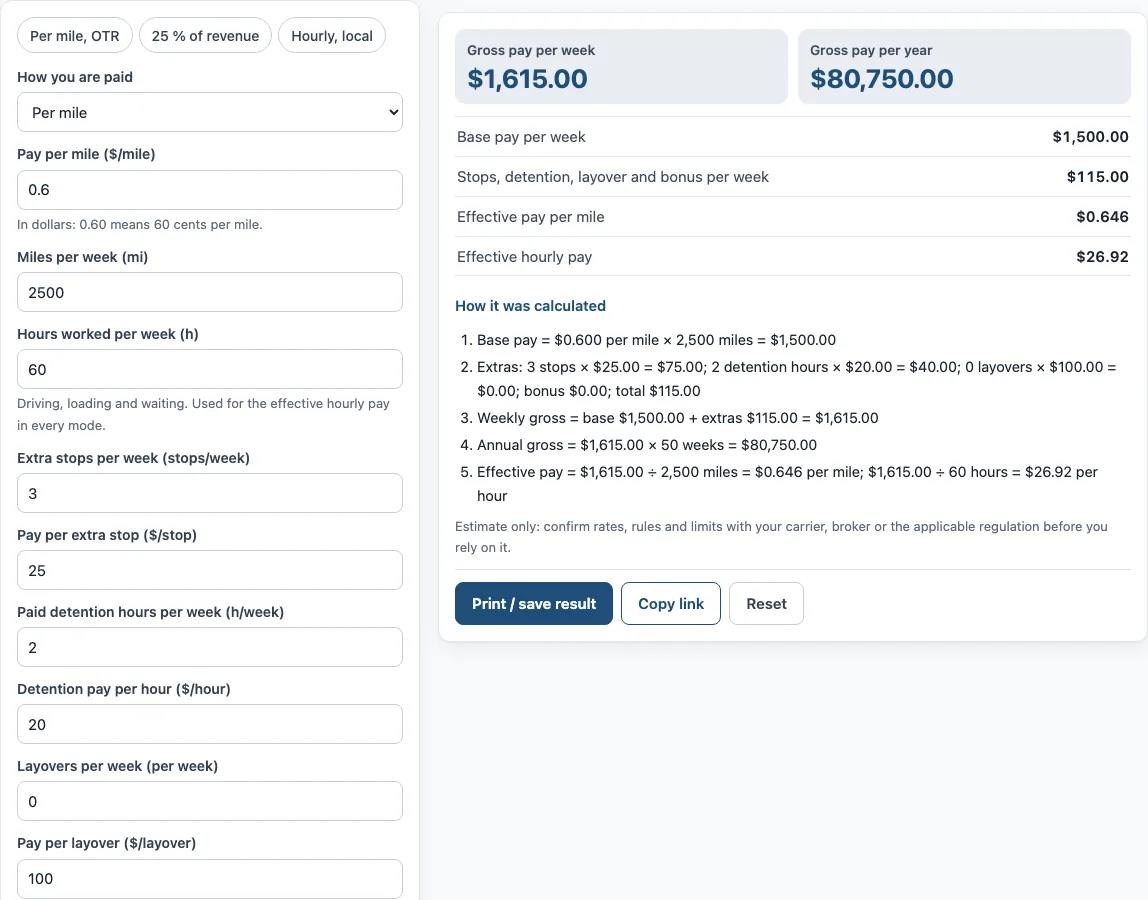
- 60 cents is $0.60, so 2,500 miles × $0.60 = $1,500 for the week.
- In the default example, $1,615 ÷ 2,500 miles gives an effective $0.646 per mile, above the $0.60 base rate.
- The same $1,615 over 60 hours gives $26.92 per hour.
- The Paid weeks per year default is 50, and the annual gross is the weekly gross multiplied by that number.
- Per diem is shown separately as Per diem per week (not in gross), because it is usually a reimbursement.
Sources: Truck driver (Wikipedia) (checked 2026-10-15)
How to use the Truck driver pay calculator
- Choose How you are paid: Per mile, Percentage of the load, or Hourly. Or click a preset: “Per mile, OTR”, “25 % of revenue” or “Hourly, local”.
- For per mile pay, enter Pay per mile ($/mile) in dollars. Type 0.60 for 60 cents per mile.
- For percentage pay, enter Your share of revenue (%) and Load revenue per week ($/week), the linehaul amount before your share.
- For hourly pay, enter Hourly rate ($/hour).
- Enter Miles per week and Hours worked per week. Hours include driving, loading and waiting.
- Add any extras: Extra stops per week and Pay per extra stop, Paid detention hours per week and Detention pay per hour, Layovers per week and Pay per layover, and Bonus per week.
- Set Paid weeks per year. The default is 50.
- Open More options to enter Per diem ($/day) and Days out per week.
- Read the results, including gross pay per week and per year, effective pay per mile and effective hourly pay.
Under the result, How it was calculated lists each step with your numbers. Print / save result creates a one-page sheet with your inputs, results, steps and the date; save it as a PDF from the print dialog. Copy link copies a link that reopens the same inputs. Reset restores the example values.
How do I calculate cents per mile pay?
To calculate cents-per-mile pay, divide the cents by 100 to get dollars, then multiply by the miles you drive. For example, 60 cents is $0.60, and 2,500 miles × $0.60 = $1,500 for the week. The tool uses this same formula for base pay, then adds any extras on top.
How much do truck drivers make per mile?
The per-mile rate is what a carrier agrees to pay for each mile driven, and it changes from job to job. This tool does not use industry averages, so the number to use is the rate in your offer or contract. Your real earnings per mile can differ from that rate, because the effective pay per mile divides your total weekly gross by the miles you drove. In the default example, $1,615 ÷ 2,500 miles gives $0.646 per mile, above the $0.60 base rate.
Is percentage pay better than pay per mile?
Neither method is better in every case; the answer depends on the revenue of the loads you haul. Percentage pay equals your share multiplied by the linehaul revenue, while per mile pay equals the rate multiplied by the miles. To compare two offers, enter both in the tool for the same week and look at the effective pay per mile and effective hourly pay. For example, if loads paid $6,000 a week, a 25% share would give $1,500, the same base pay as 2,500 miles at $0.60.
How do I work out my hourly rate as a driver?
Your effective hourly rate is your weekly gross pay divided by the hours you worked that week. The tool counts driving, loading and waiting as hours worked. In the default example, $1,615 ÷ 60 hours = $26.92 per hour. If you are paid hourly, base pay is your hourly rate multiplied by your hours, and the extras are added before the division.
Detention and stop pay are paid on top of the base, so they raise the effective pay per mile and per hour.
Sources
No pay rates are built in: every rate is the figure from your own offer or contract, and the tool only applies the arithmetic shown in the steps.
Frequently asked questions
Is per diem part of a driver’s gross pay?
No. Per diem is a daily allowance for meals and incidentals on the road, so the tool shows it separately as “Per diem per week (not in gross)”. It is left out of gross pay because it is usually a reimbursement and may be treated differently for tax. “Weekly pay plus per diem” adds the two together for a combined view only.
Does the calculator include overtime?
No. Hourly pay is calculated without overtime. Many trucking jobs are exempt from federal overtime rules under the Motor Carrier Act exemption, but check your own contract and state law.
Why is my effective pay per mile different from my rate?
Effective pay per mile divides all weekly gross pay, including stops, detention, layovers and bonuses, by the miles driven. Your base rate covers only the miles themselves, so the two numbers will differ whenever extras are paid. Use the effective figure to compare offers that pay in different ways.
Why does the annual figure use 50 weeks?
The default of 50 paid weeks allows for two weeks of unpaid time off. Change Paid weeks per year to match your own schedule, and the annual gross will be your weekly gross multiplied by that number.
Related tools
- Trucking cost per mile calculator: Use it to compare what a load costs to run against the rate you are paid per mile.
- Fuel surcharge calculator: Use it to work out the fuel surcharge that can be added on top of a freight rate.
- IFTA calculator: Use it to estimate fuel tax across the states you drive through.
- Axle weight calculator: Use it to check how weight is spread across the axles of a truck.
- Bridge formula calculator: Use it to check whether a truck’s axle spacing and weight meet the bridge formula.
- Truck loading calculator: Use it to plan how cargo fits and is loaded in a trailer.